Fort Bend voters trust MUDs and city halls more than Austin
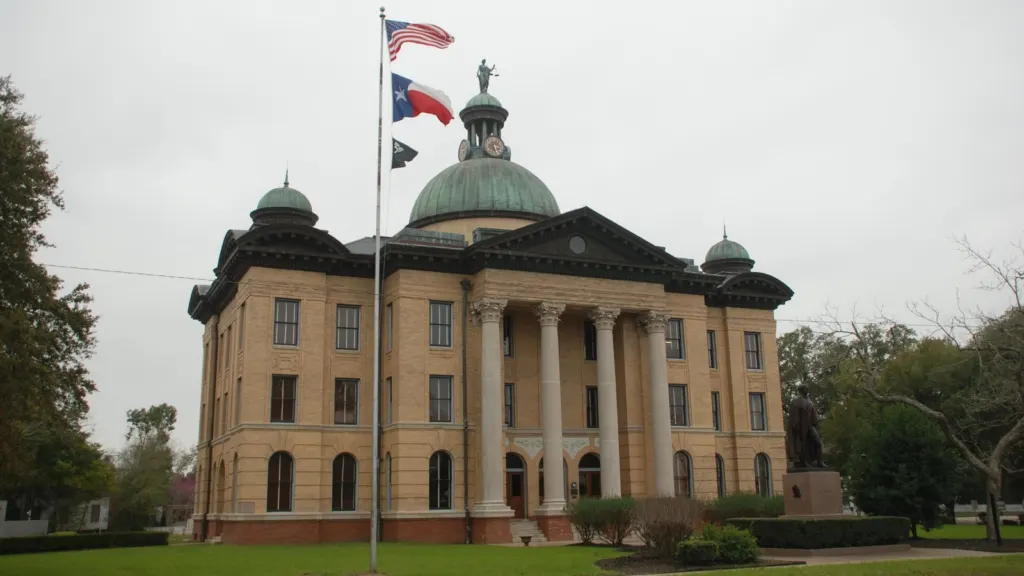
The Fort Bend County Courthouse in Richmond. Photo: Adavyd, CC BY-SA 4.0, via Wikimedia Commons.
Fort Bend County voters trust the governments closest to them far more than the ones in Austin and Washington, and that includes the municipal utility districts that most of them live in, according to a new survey from Texas Southern University.
The November report from TSU’s Barbara Jordan Public Policy Research and Survey Center polled 1,800 registered voters in the county between Sept. 29 and Oct. 6. Its headline number, that 61% think the county is growing too quickly, was first reported by Houston Public Media. The rest of the 2026 report says a lot about how a fast-growing, majority-unincorporated suburb actually experiences local government.
Fort Bend is the eighth most populous county in Texas and, the authors note, the most ethnically and racially diverse. More than half of the voters surveyed, 57%, live outside any city. Almost two-thirds, 65%, live inside a MUD.
Trust runs local
The survey asked how often voters can trust each level of government “to do what is right.” Counting those who answered “just about always” or “most of the time,” the results ran in a clear line from near to far:
- City governments: 51% (among voters who live in a city)
- Municipal utility districts: 44% (among voters who live in one)
- Fort Bend County government: 41%
- School districts: 39%
- Texas state government: 25%
- U.S. federal government: 19%
MUDs are easy to overlook. They are special districts that build and run water, sewer and drainage for new subdivisions and pay for it with their own property tax, usually with boards that meet with little public attention. In much of Fort Bend, the MUD is the government that gets a resident’s water to the tap. The report found 49% of MUD residents rate their district’s job as excellent or good, while 14% rate it poor.
Among cities, Sugar Land led. Sixty percent of Sugar Land voters said they trust their city government most of the time or better, and 66% rated its performance excellent or good. Missouri City followed at 55% and 56%. Voters in the county’s other cities, a group that includes Fulshear, Katy, Richmond, Rosenberg and the Fort Bend slice of Houston, came in at 42% and 41%.
Who feels heard
The most unusual finding is about which voters feel county leaders care what they think. Overall, 59% agreed that Fort Bend’s elected officials care about “people like me.” Black voters were the most likely to agree, at 72%, compared with 57% of White voters, 56% of Asian American voters and 50% of Latino voters. Voters 55 and older (78%) were far more likely to agree than those 18 to 34 (47%).
Mark P. Jones, the Rice University political scientist who co-wrote the report with TSU’s Michael O. Adams, told Houston Public Media that it is rare in Texas for Black voters to be the group that feels most heard, and he credited active engagement by the commissioners in the county’s two majority-Black precincts.
Growth splits the county
On growth, the divide follows race, party and geography. Seventy percent of White voters and 66% of Latino voters said the county is growing too fast, compared with 52% of Asian American voters and 48% of Black voters. Three in four Republicans agreed, against half of Democrats. By commissioner precinct, the share ranged from 78% in Precinct 1 to 45% in Precinct 3.
Only 1% said Fort Bend is growing too slowly. Participation is modest: in the past year, 20% contacted a county office or official, and 14% attended a public meeting in the county.
The findings land as Houston-area governments face pressure over how they spend and whom they answer to, from Harris County’s pulled facial recognition contract to the special districts that handle drainage, explained in our guide to how the Harris County Flood Control District works. Fort Bend’s diversity, which shapes communities like those in our guide to Houston’s Nigerian community, also shows in these numbers.
For residents who want their views on growth on the record, the next chance is Fort Bend County Commissioners Court, which takes public comment at its regular meetings, and their own MUD board, whose meeting notices are posted at least 72 hours in advance. More of our coverage of the region is in Local News.
Add The City Reporters as a preferred source on Google (opens in a new tab)
 By