Feral hogs dig up Galveston County yards: what Texas law allows
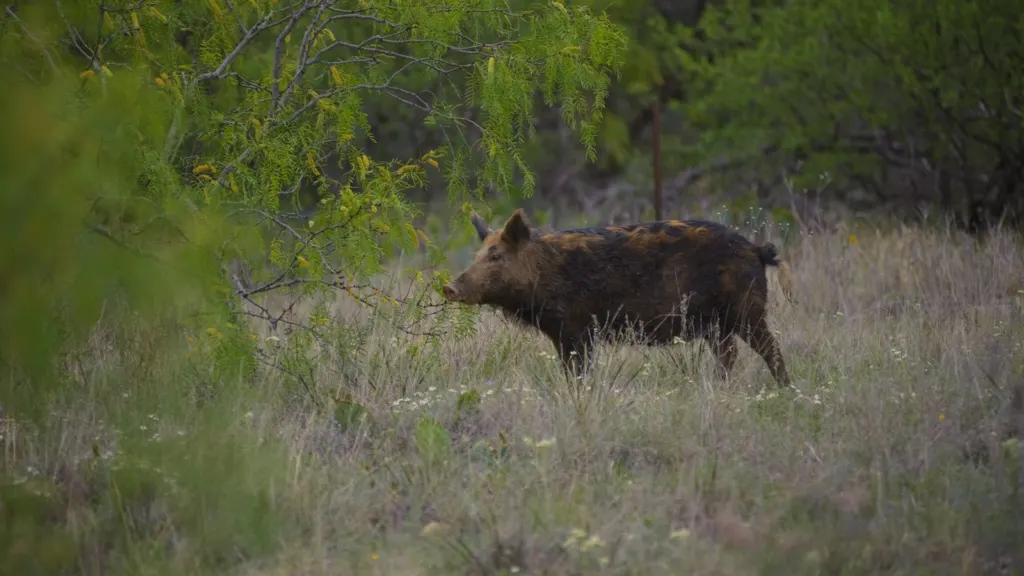
A feral hog on a ranch in Albany, Texas. Photo: USDA NRCS Texas, public domain, via Wikimedia Commons.
Cooler weather is bringing feral hogs out of the brush and into backyards south of Houston. Residents around Friendswood, Hitchcock and Crystal Beach have reported wild hogs ripping up lawns and tearing into trash, Houston Public Media reported on Nov. 19.
For a homeowner waking up to a front yard that looks plowed, the practical questions come fast: what draws them, what keeps them out, and what the law allows once they are trapped. Texas has fairly specific answers.
A statewide problem moving into subdivisions
Feral pigs live in 250 of Texas’s 254 counties, according to the Texas A&M Natural Resources Institute, which puts the state’s population at more than 3 million. The institute estimates they cause more than $670 million in crop damage a year, with roughly another $200 million spent on control. Those figures leave out vehicle collisions, water quality problems and disease, and they leave out suburban yards.
Jay Long of the institute told Houston Public Media that replacing a torn-up lawn can run a homeowner about $5,000, and that he has seen whole front yards stripped of sod, sometimes with sprinkler lines cracked. Edward Dickey of Texas Wild Hog Control told the station that hogs eat more as temperatures drop and that watered lawns soften the soil, making grubs and insects easier to dig up. He pointed to new subdivisions built on land hogs already used.
The animals breed fast. The institute notes that females can conceive at 6 months old and carry a litter for about 115 days, which is why a few sightings can turn into a recurring problem.
Keeping them out
The advice from both men, as reported by Houston Public Media, is to cut off the food. That means reducing how much you water, treating the lawn for grubworms, securing trash and removing deer feeders or other feed. Long suggested picket or electric fencing for properties that keep getting hit. Both recommended calling a trapper rather than handling the problem alone, and both warned against approaching a hog. They usually avoid people, but can turn dangerous when cornered.
Texas A&M has a free set of feral pig publications, including one on small acreage and metropolitan areas, through its Natural Resources Institute.
What Texas law says
Feral hogs are treated as exotic livestock, not game. There is no closed season and no bag or possession limit. Since September 2019, a hunting license is not needed to hunt or trap them on private land if you are the landowner or have the landowner’s permission, under Parks and Wildlife Code 42.002(c). A license is still required on public land, and hunter education certification still applies. Texas Parks and Wildlife asks hunters to check the current Outdoor Annual for changes.
There is a catch that surprises some people. Under the Agriculture Code, whoever traps a feral hog and pens or cares for it becomes its owner and is responsible for it. Moving a live hog is tightly limited. The Texas Animal Health Commission prohibits transporting or releasing live feral swine except directly to a recognized slaughter facility, an approved holding facility or an authorized hunting preserve, in escape-proof enclosures. Dickey said trapped hogs end up euthanized, at a certified buying station or at a certified high-fence hunting ranch.
Inside city limits, check local ordinances before anyone considers shooting; trapping by a professional is the route both men recommended. Dickey said his company uses corral traps that can catch more than 65 hogs at once, though 15 to 20 is typical, and that doing it right takes a few weeks.
The hogs are one more side effect of how fast the region is building out, a theme residents raised in a recent Fort Bend County survey on growth. For more on living with the Gulf Coast’s land and water, see our explainer on how the Harris County Flood Control District works and other stories in Community.
Add The City Reporters as a preferred source on Google (opens in a new tab)
More in Community
Astrodome pitches range from an indoor ski run to a $990 million ‘Space City,’ report shows
Houston Grand Opera’s ‘Breaking the Waves’ earns the company its fifth Grammy nomination
 By Dana Kowalczyk ·