ERCOT puts January’s grid emergency risk at 3.2%, highest around 8 a.m.
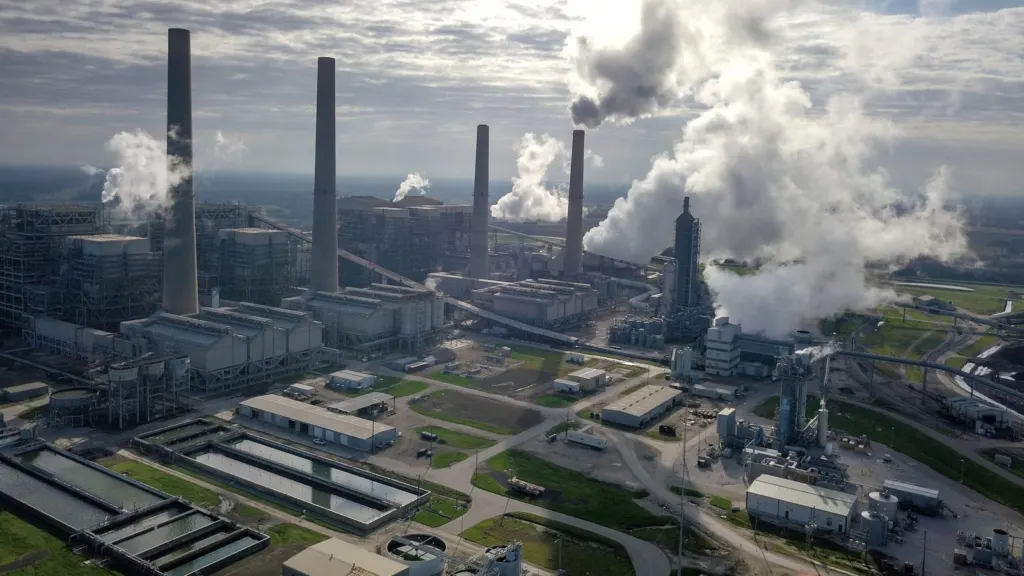
The W.A. Parish Generating Plant in Fort Bend County, one of the largest power plants on the ERCOT grid. Photo: RM VM, CC BY-SA 4.0, via Wikimedia Commons.
ERCOT’s first look at January puts the chance of a grid emergency on the coldest morning of the month at about 3 in 100, and says the riskiest stretch is the hours when Houston is getting up and heading to work.
The grid operator’s Monthly Outlook for Resource Adequacy for January 2027, published Nov. 6, finds the highest risk at the hour ending 8 a.m. Central time, with a 3.20% chance that ERCOT would need to declare an Energy Emergency Alert. The 7 a.m. to 9 a.m. window carries most of the risk. ERCOT treats anything at or above 10% as elevated, so January is well under that line.
Why mornings
On a winter morning, heating demand is high and there is no solar output yet. Batteries have to cover the gap until the sun comes up, and wind is hit or miss. The report also notes a smaller rise in risk in the evening, which it ties to cold-weather load and to crypto-mining demand.
In a normal January, ERCOT expects demand at that 8 a.m. peak hour of 78,912 megawatts, its middle-of-the-road forecast. Under those conditions the report shows a 44.9% reserve margin, with about 80,200 MW of gas, coal and nuclear capacity, 16,151 MW of wind and 13,275 MW of battery output available. The fleet has 21,528 MW of batteries installed.
That is a comfortable cushion on an ordinary day. The risk number exists for the day that is not ordinary.
What could go wrong
The biggest wild card in winter is power plants breaking down in the cold. The report assumes 8,105 MW of thermal capacity offline for planned and unplanned outages under normal conditions. It also says unplanned thermal outages in January 2026 were “significantly higher” than in January 2025 and moderately higher than January 2024.
One large unit will be out regardless. Sandy Creek Unit 1, a 933 MW coal plant near Waco, is listed on extended outage. Since the December outlook was prepared, ERCOT says 1,178 MW of new winter capacity has been added: 807 MW of storage, 325 MW of solar and 46 MW of gas.
This is also the first outlook to use a new model for how the battery fleet charges and discharges during the day. ERCOT says it better reflects how batteries actually save energy for the tightest hours, and that it lowers the calculated risk slightly compared with the old method.
The report has a limit worth knowing. It accounts for wind curtailment on lines out of South Texas, but it does not capture emergencies caused by transmission limits into Far West Texas. A local outage in Houston, from ice on lines or a failed substation, is a separate problem from a statewide shortage and is handled by CenterPoint, not ERCOT. Our coverage of CenterPoint’s post-Beryl rebuild tracks that side.
New alerts by text
If conditions do tighten, ERCOT now has a new way to tell you. On Nov. 10 it relaunched its Texas Advisory and Notification System, known as TXANS, as the single source for grid notices, and added text messages for the first time. Alerts go out in English and Spanish.
“We have enhanced TXANS as a more efficient, streamlined way to communicate with the public,” ERCOT President and CEO Pablo Vegas said in the release.
The alert levels, from mildest to most serious:
- Weather Watch: a heads-up days ahead when bad weather or high demand could tighten reserves. The grid is still normal.
- Voluntary Conservation Notice: ERCOT asks people to cut use during a set window if it is safe to do so.
- Conservation Appeal: the grid could enter emergency operations. Conserving matters more.
- EEA Level 1: reserves below 2,500 MW and not expected to recover within 30 minutes.
- EEA Level 2: reserves below 2,000 MW, or frequency below 59.91 hertz for 15 minutes.
- EEA Level 3: reserves below 1,500 MW, or frequency below 59.8 hertz. Rotating outages are underway statewide.
To sign up, go to ercot.com/txans and pick email, text or both. Current subscribers can log in with their registered email to add a phone number. ERCOT says anyone with critical medical needs should also check with their local utility, which for most of Houston means CenterPoint.
What to watch
ERCOT updates these outlooks monthly, so a December report for February is next. A deep freeze would change the numbers fast. The same report includes a separate chart of EEA risk during a severe winter storm across a range of peak demand levels, which is the scenario to check if a hard freeze shows up in the forecast.
For more on how Houston’s power gets made and moved, from CenterPoint’s TALON project to new geothermal at Fervo Energy, see our Energy section.
Add The City Reporters as a preferred source on Google (opens in a new tab)