Fervo’s Tim Latimer took shale drilling to geothermal. This fall, it started selling power
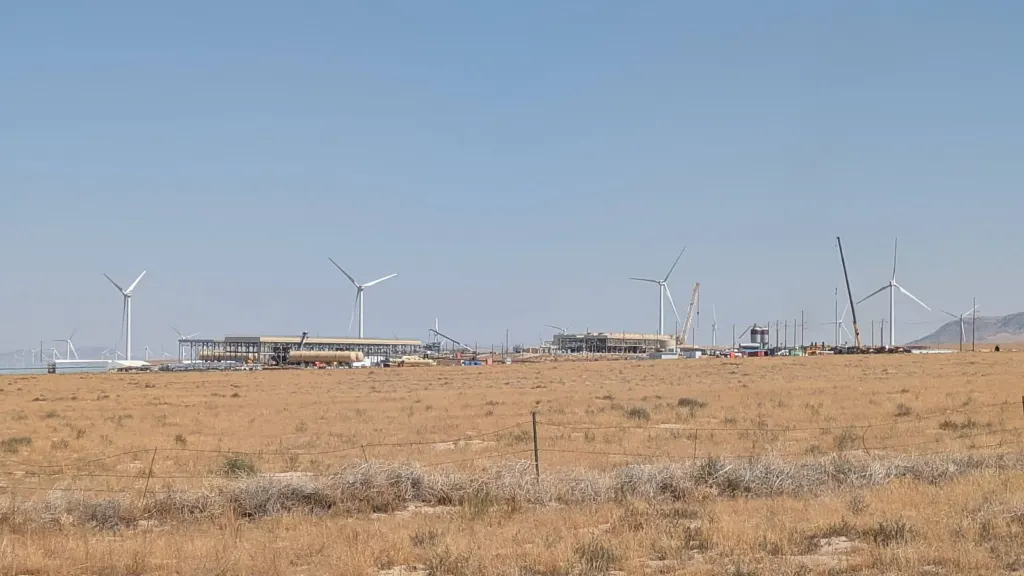
Fervo Energy's Cape Station during Phase 1 construction in Beaver County, Utah, in 2025. Photo: Braddah n8, CC0, via Wikimedia Commons.
For most of its history, geothermal power was the renewable that never quite arrived. It worked in a handful of places where hot rock sat close to the surface, and it stayed expensive and small everywhere else. Tim Latimer’s bet, made in 2017 when he was in his twenties, was that the drilling know-how Texas built for shale oil could change that.
This October, that bet started selling electricity. The first 33-megawatt unit at Fervo Energy’s Cape Station in Beaver County, Utah, began producing power for sale, with Shell Energy as the first customer. It is the Houston company’s first commercial plant, and it arrives in a year when Fervo has gone public, signed its largest-ever deal with Google and become one of the most closely watched energy companies in the country.
From the oil patch
Latimer trained as a mechanical engineer and spent the early part of his career as a drilling engineer at BHP, working in the shale fields during the boom years. He left in 2015. What he took with him was a conviction that the horizontal drilling and multi-stage fracturing techniques that unlocked shale oil could be pointed at heat instead of hydrocarbons.
He co-founded Fervo in 2017 with Jack Norbeck, a reservoir engineer who is now the company’s chief technology officer. The idea, called an enhanced geothermal system, is to drill into hot, dense rock, create fractures, then circulate water down one well and pull it back up another, hot enough to spin a turbine. The rock doesn’t have to come with natural hot water. That opens up far more of the map.
The first proof came in 2023 at Project Red in northern Nevada. Two wells reached about 8,000 feet down with horizontal sections of roughly 3,250 feet, and the pilot produced around 3.5 megawatts of steady, around-the-clock power. It was the first time horizontal wells had been used in an enhanced geothermal system, and it fed electricity to the grid that serves Google’s Nevada data centers.
A Houston company in a Houston industry
Fervo keeps its headquarters in Houston, and that is not an accident. The company’s workforce, suppliers and investors overlap heavily with the oil and gas world. Shale producer Devon Energy is a backer, alongside Bill Gates’ Breakthrough Energy Ventures. Many of the rigs, crews and service companies that drill Fervo’s wells came out of the Permian and other Texas basins.
That has made Fervo a useful example for Houston leaders who argue the city can stay the energy capital as the mix changes. The skills that built the oil business are transferable, and geothermal is one of the clearest places to see it.
A big year
In May, Fervo raised $1.89 billion in an initial public offering on Nasdaq under the ticker FRVO, pricing at $27 a share, above its marketed range. The stock jumped 35% on its first day, giving the company a market value of about $10.4 billion, Bloomberg reported. Latimer kept about 48% of the voting power after the offering.
“There’s just a laser focus of investors right now on what are we going to do to solve the power demand imbalance we’re seeing in the country right now,” Latimer told Bloomberg at the time.
In September, Fervo signed a 15-year agreement to supply Google with 396 megawatts from Cape Station, delivered in tranches starting in 2028. Google has an option for roughly 600 megawatts more, which would bring the total close to a gigawatt by mid-2030, Reuters reported. Fervo also has contracts with Southern California Edison and Shell.
The data center boom is a big part of why. Tech companies need power that runs all day and night, and most want it to be carbon-free. Wind and solar can’t provide that without large amounts of storage. Geothermal can. It has also largely avoided the federal pushback that has hit wind and solar projects, which has helped Fervo and its competitors.
What’s still unproven
None of this means the hard part is over. Fervo lost $70.5 million in 2025 on almost no revenue, according to its IPO filings. Cape Station still has to show it can deliver its planned capacity on schedule, and the industry’s long-term questions are real: how much drilling costs will fall, how productive wells stay over decades and whether the model works in places with less heat than southwest Utah. Geothermal still makes up less than 1% of global electricity.
Latimer has said a lot of his job is explaining the business to people who’ve never thought about it. “Whether you’re a power sector lifer or you’re a tech investor that’s trying to wrap their heads around how do you actually power these data centers, we find we spend a lot of time kind of teaching people what our role in the sector is,” he told Bloomberg.
With electricity now coming out of Cape Station, he has something new to point to.
 By