Houston adds 10 protected landmarks, led by Third Ward’s Trinity United Methodist
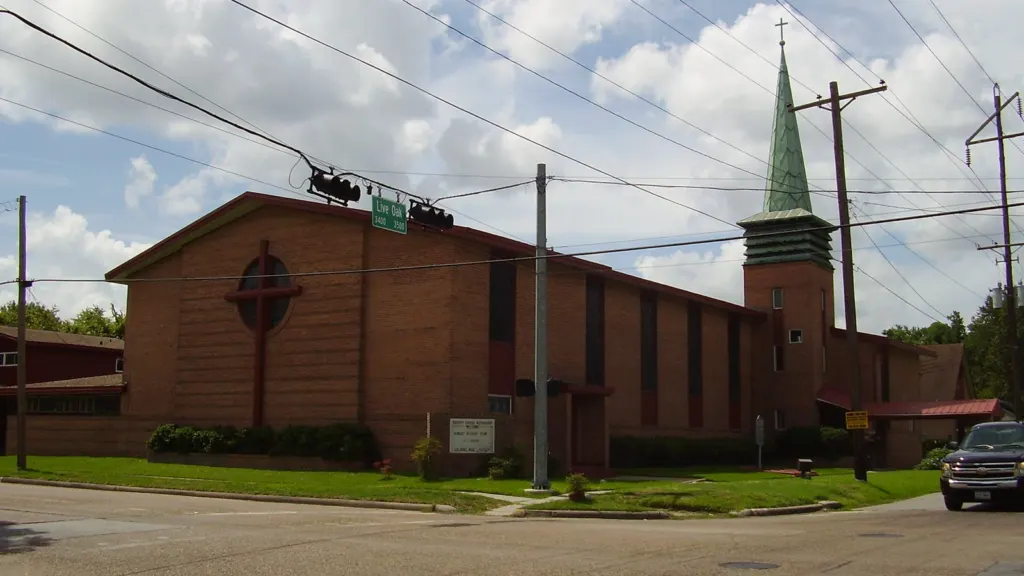
Trinity United Methodist Church at Holman and Live Oak in the Third Ward. Photo: WhisperToMe, public domain, via Wikimedia Commons.
Houston City Council has added 10 buildings to the city’s list of protected landmarks, and the one with the longest history is a brick church on Holman Street in the Third Ward whose congregation began with enslaved worshippers before the Civil War.
Trinity United Methodist Church, at 2600 Holman, joins nine houses and churches approved over the past two weeks, Houston Public Media reported Monday. Council also granted landmark status, with a tax exemption, to the First City National Bank building at 1021 Main Street downtown.
The vote comes a few weeks after the Kirby Mansion was torn down on Oct. 30, a loss preservation advocates have pointed to as a reason to lock in protection for buildings while they are still standing. Houston now has more than 200 protected landmarks, the station reported.
What the city’s report says about Trinity
The church’s application, file HP2026_0351, was accepted in December and heard by the Houston Archaeological and Historical Commission on Feb. 12. The landmark designation report, written by Emily Ardoin of Preservation Houston, traces the congregation to the enslaved members of Houston’s earliest Methodist church.
Its first building, from about 1851, was built by its Black congregants on the property of Houston’s Methodist church. After emancipation, trustees bought land at Travis and Bell in 1866 and moved the building there. The report quotes the 1915 Red Book of Houston calling Trinity “the mother” of the city’s 10 Methodist Episcopal churches.
Pastor Elias Dibble and several of the same trustees helped secure Emancipation Park and Olivewood Cemetery for Black Houstonians. Church members had a hand in founding the Mutual Aid Society of Houston, the Gregory Institute, Wiley College and Texas Southern University, according to the report.
Fire heavily damaged the church in 1946. The congregation then bought land at Holman and Live Oak and hired the architects George Pierce and Abel B. Pierce, whose 1951 sanctuary the report describes as an early example of postwar modern church design in Houston: a traditional church form with restrained modern detailing. In 1995 the congregation added 11 stained-glass windows by artist Laura Jean Lacy depicting Black history and the civil rights movement.
The designation covers only the 1951 sanctuary, education building and parsonage, not the older church next door that the congregation bought and remodeled in the 1990s. The state named the building a Recorded Texas Historic Landmark in 2025, and city staff found it met six of the city’s landmark criteria.
The other nine, and a debate coach’s house
The rest of the new protected landmarks, as listed by Houston Public Media:
- House at 1317 Ruthven
- Berean Seventh-Day Adventist Church, 2119 St. Emmanuel St.
- Irene and George Robinson House, 2322 Dunstan Road
- Myrle and Vernon Williams House, 2107 Tangley St.
- Ince-Crain House, 1914 Dunstan Road
- Helen and Jesse O. Webb House, 2232 Dunstan Road
- Myer-Jones House, 2232 Tangley St.
- Mae and John Wallace Donaldson House, 2306 Tangley St.
- Doney-McElwain-Freeman House, 2522 Calumet St.
Six of the nine are houses on Dunstan Road and Tangley Street near Rice Village. The Calumet Street house belonged to Thomas F. Freeman, who founded Texas Southern University’s debate team, and his wife, who is 106. District D Council Member Carolyn Evans-Shabazz singled it out, telling the station that “it’s very important that we don’t just walk into the future without remembering our historical past.” Three of the new landmarks are in her district.
Protected status matters for owners in two ways. It is the city’s strongest shield against demolition, and it makes the buildings eligible for historic property tax exemptions. Owners have to ask for it, which is why the list tends to grow a few buildings at a time.
The designations add to a year in which old Houston buildings have kept making news, from the Garden Oaks Theater rescue to the long wait over the Astrodome’s future. Trinity’s neighborhood also produced bluesman Lightnin’ Hopkins. Applications for new designations go to the city’s Historic Preservation Office and then to the Houston Archaeological and Historical Commission, which meets monthly. More City Hall coverage is in our Local News section.
Add The City Reporters as a preferred source on Google (opens in a new tab)