Harris County life expectancy runs from 86 years in West U to under 69 in Sunnyside, county report finds
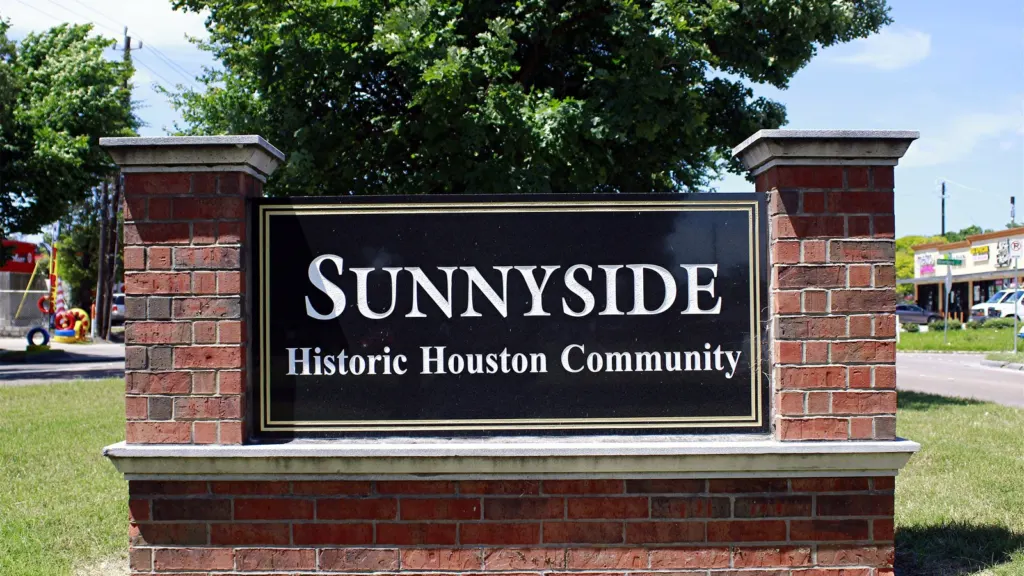
The Sunnyside community sign near Scott Street and Bellfort Avenue. Photo: 2C2K Photography / Wikimedia Commons, CC BY 2.0
A child born in West University Place can expect to live about 86 years. In Sunnyside, on the city’s south side, the figure is under 69. In ZIP code 77507, which the county labels Edgebrook-Ellington, it is under 60.
Those numbers come from Harris County Public Health’s new leading causes of death report, which calculates life expectancy at the ZIP code level for 2021 through 2025. The department says it built its own estimates because the national sources it used to rely on were outdated or incomplete. Data for 2024 and 2025 are provisional.
A 20-year gap inside one county
Across the county, life expectancy at birth reached 79.5 years in 2025, the highest of the five years studied. It had fallen to 75.9 in 2021, the lowest since 2015, which the report attributes largely to COVID-19. It has not fully recovered: in 2019 the countywide figure was 79.6.
The neighborhood spread is far wider than the county trend. The three highest-ranking ZIP code areas averaged 85.0 years and the three lowest averaged 64.5, a gap of 20.5 years:
- 77005 (West University Place): 86.3 years
- 77027 (River Oaks): 84.6 years
- 77024 (Memorial area): 84.0 years
- 77051 (Sunnyside-Greater Hobby): 68.6 years
- 77002 (Downtown): 65.3 years
- 77507 (Edgebrook-Ellington): 59.7 years
The report adds caveats for two of those. ZIP 77507 is largely industrial with a small population, which can distort the calculation. Downtown’s figure may reflect the large number of deaths among people experiencing homelessness.
The county’s own explanation for the gap is social, not medical: differences in health care access, income, housing, transportation and access to healthy food. The report notes that Commissioners Court Precincts 3 and 4 have consistently had higher life expectancy than Precincts 1 and 2.
Downtown’s odd double ranking
One detail stands out. Downtown’s 77002 is also the ZIP code with the biggest improvement in the county from 2015 to 2025, up 19.8 years. It was followed by 77030, home to the Texas Medical Center, at 10.7 years, and 77050 at 9.9. The largest declines over the same decade were in 77003, just east of downtown, down 12.1 years, then 77012 (down 5.2) and 77547 (down 4.4).
So downtown has gained more than any other ZIP code and still ranks second-lowest in the county. Small populations can make ZIP-level numbers swing sharply, which is one reason the department reports them with caveats.
The 10 highest-ranked ZIP codes have stayed between roughly 83 and 84 years since 2015. The bottom 10 have ranged from about 65 to 71. The report says the pandemic widened the gap, with steeper declines in neighborhoods that faced crowded housing, limited access to care and transportation barriers.
What is killing Harris County residents
The county recorded 156,892 deaths from 2021 through 2025. Heart disease and cancer were the top two causes in every year except 2021, when COVID-19 moved into second place. From 2021 to 2024, drug toxicity, motor vehicle crashes and other blunt trauma were the leading causes of accidental death.
For children ages 1 to 17, unintentional injuries were the leading cause every year. Homicide was second every year until 2025, when suicide moved ahead of it. Firearms accounted for 36.9% of deaths across the accidental, assault and self-harm categories, with the highest share among 16- and 17-year-olds. Motor vehicle crashes were the leading cause of accidental child deaths, and drowning was usually second.
Among racial and ethnic groups, non-Hispanic Asian residents had the highest life expectancy throughout the period and non-Hispanic Black residents the lowest, a gap of about 12 to 13 years before the pandemic. By 2025, the report says, most groups had not returned to pre-pandemic levels, except non-Hispanic Black residents.
The department says the findings will guide where it targets programs. For more on how county money is being directed, see our coverage of Commissioners Court grant decisions and the county’s higher tax rate. For housing efforts aimed at people leaving homelessness, see our story on Bread of Life’s Knowles-Rowland House.
Add The City Reporters as a preferred source on Google (opens in a new tab)
 By