William Marsh Rice got rich in Houston, was murdered for his fortune, and now rests under a moved statue
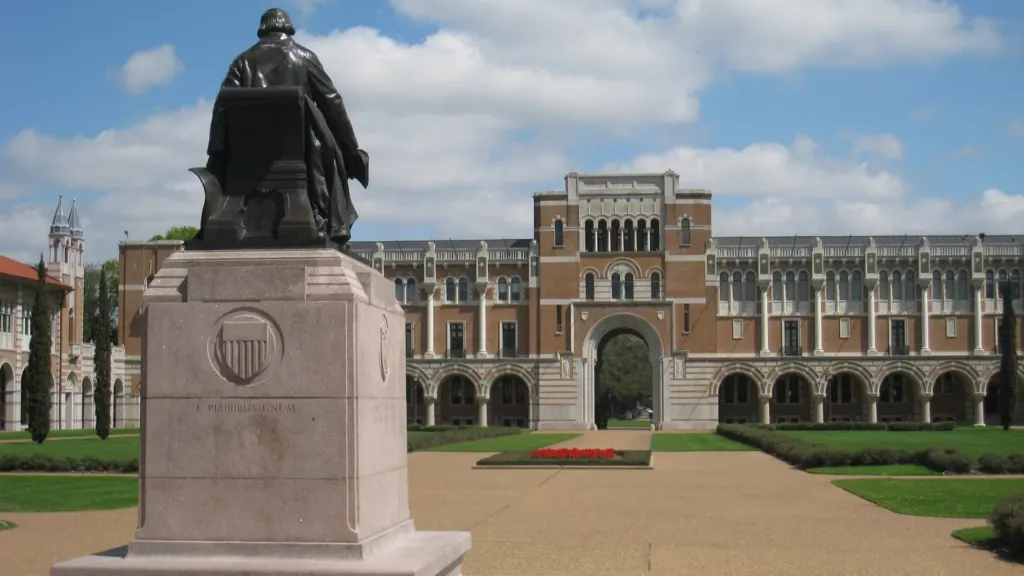
The Founder's Memorial at its former spot in the center of the Academic Quad, facing Lovett Hall. Rice moved the statue to a terrace beside Lovett and Sewall halls in 2024. Photo: Daderot / Wikimedia Commons, public domain
William Marsh Rice made his fortune in Houston, spent most of his later life in New Jersey and New York, and was murdered in New York City in 1900 by men trying to steal that fortune. The university that carries his name exists because the scheme failed. Today his ashes rest under a bronze statue on the Rice University campus, in a spot the school chose two years ago after a long look at the whole of his story.
A clerk who came to Houston
According to the Handbook of Texas, Rice was born in Springfield, Massachusetts, on March 14, 1816. He left school at 15 to clerk in a general store and owned his own business by 21. After the Panic of 1837 he moved to Houston, where his first job was running the bar at the Milam Hotel. The city licensed his mercantile business on June 28, 1840.
From there he built a large trading business. With Ebenezer B. Nichols he ran Rice and Nichols, an import and export firm that supplied inland plantations and settlers with goods from New Orleans and New York, and acted as a banker for many customers. He helped found the Houston and Galveston Navigation Company in 1851 and the Houston Cotton Compress Company in 1859. He was an incorporator and director of several railroads, including the Houston and Texas Central, and owned a brig that hauled ice from Boston to Galveston in the summers. He also served as a Second Ward alderman from 1855 to 1857.
By 1860, the Handbook says, he may have been the second-richest man in Texas. The same entry records that he owned 15 enslaved people that year and served for a year on a slave patrol, even though he identified with the Union cause.
War, New Jersey and a hotel downtown
When the Civil War began, Rice left his Houston home to be used as a military hospital and moved his business to Matamoros, Mexico, operating through the federal blockade. After the war he settled in Dunellen, New Jersey, but kept his Texas interests. In 1885 he bought the Capitol Hotel downtown, which became the Rice Hotel.
In 1891 he endowed and incorporated the William Marsh Rice Institute for the advancement of literature, science and art. He was a director of the Houston Academy and a trustee of several schools, including the Texas Medical College.
The murder and the will
Rice moved to New York City after his second wife, Julia Elizabeth Baldwin Brown, died in 1896. By then his fortune was about $3 million. On Sept. 23, 1900, he was murdered by his valet, Charles F. Jones, and Albert T. Patrick, a lawyer who had forged a series of documents to take control of the estate.
Years of court fights followed. Patrick was sentenced to death but received a full pardon in 1912. That same year, the Handbook notes, the bulk of the estate went to the Rice Institute, which opened in Houston that year.
The statue, moved
For decades John Angel’s statue of Rice sat at the center of the Academic Quadrangle, facing Lovett Hall. In 2019 then-President David Leebron commissioned a Task Force on Slavery, Segregation and Racial Injustice. Its work led trustees to announce a redesign of the quad in January 2022, after a review that drew more than 1,200 comments from students, faculty, staff, alumni and community members.
The new quad opened on Sept. 12, 2024. The Founder’s Memorial now stands on a paved limestone terrace where Lovett and Sewall halls meet, surrounded by a garden. “We intended for the redesigned Academic Quadrangle to both fully acknowledge the history of our founding and generous founder, William Marsh Rice, and to mark and celebrate the important evolution and growth of our university over time,” board chairman Robert T. Ladd said at the opening.
The memorial’s old granite base was put to new use at the center of the quad. It is now a platform engraved with a line from John F. Kennedy’s “We choose to go to the Moon” speech, delivered at Rice Stadium in 1962.
Seeing it
The statue is on the Rice campus at 6100 Main St., on the terrace where Lovett and Sewall halls meet. Rice’s name is still all over Houston, from the university now building in the Ion District to the downtown hotel he bought. His story sits beside other Houston builders such as Jesse H. Jones and Dominique de Menil in our Spotlight section.
Add The City Reporters as a preferred source on Google (opens in a new tab)