Dominique de Menil left wartime France for Houston and gave the city the Rothko Chapel and a free museum
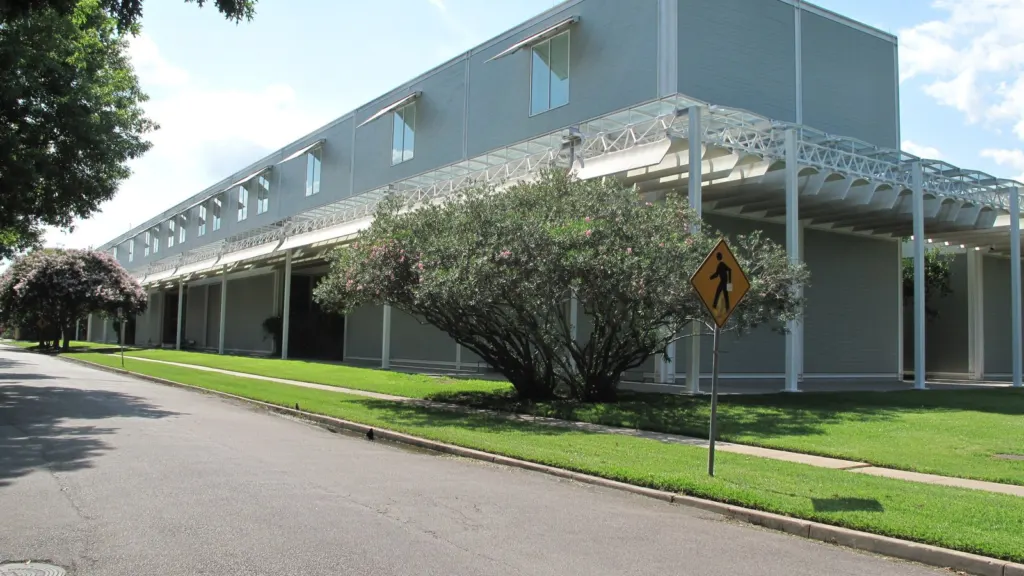
The Menil Collection's main building, designed by Renzo Piano, on the museum's Montrose campus. Photo: Francisco Anzola / Wikimedia Commons, CC BY 2.0
Dominique de Menil arrived in the United States in January 1941, after she and her husband left wartime France. She was the daughter of an oil-services fortune, and Houston was where the family business had offices. By the time she died in the city 56 years later, she had left it a chapel known around the world, a free museum on a 30-acre campus in Montrose and a reputation as one of the most serious art patrons of the 20th century.
The facts of her life, as set out in the Handbook of Texas, read like the story of Houston’s long pull between oil money and the wider world.
From Paris to Houston by way of Schlumberger
She was born Dominique Isaline Schlumberger in Paris on March 23, 1908, the second of three daughters of Conrad and Louise Schlumberger. Her father was a physicist whose measurement technology became essential to oil drilling, and with his brother he founded the company that still carries the family name. She studied mathematics and physics at the Sorbonne.
In 1930 she met Jean de Menil at a party in Versailles, and they married on May 8, 1931. The couple, who opposed fascism, left France during World War II. By 1944 the family had settled permanently in Houston, which had long been home to some of Schlumberger’s operations. Jean became John, and the de Menils raised five children here. Dominique became a U.S. citizen in 1962.
That path, from a European family firm to a Texas oil city, has been followed by many Houstonians since. Few turned it into a cultural mission the way the de Menils did.
A Philip Johnson house and a chapel for Rothko
The couple started collecting seriously in the mid-1940s. In 1948 they hired Philip Johnson, then the architecture curator at New York’s Museum of Modern Art, to design their house in River Oaks. It was Johnson’s first commission for a client and is considered the first International Style building in Texas.
In 1954 they founded the Menil Foundation and became major benefactors of the University of St. Thomas, where Dominique de Menil eventually ran the art history department. In 1964 she commissioned Mark Rothko to paint 14 canvases for what was first planned as a Catholic chapel at the university. After disputes with St. Thomas, the chapel was built on a nearby site as a nonsectarian space for art, spirituality and human rights. The Rothko Chapel opened in 1971.
The de Menils also backed civil rights causes. Their foundation sponsored the De Luxe Show, an exhibition of work by Black artists at the De Luxe Theater in Houston’s Fifth Ward, and Dominique started the research project that became The Image of the Black in Western Art.
The museum on Sul Ross Street
John de Menil died on June 1, 1973. By 1980 his widow had decided to build a museum for the collection, and she hired Renzo Piano, then best known as one of the architects of the Centre Georges Pompidou in Paris. It was his first U.S. commission.
The Menil Collection opened on June 4, 1987, a long, low gray building lit largely by daylight filtered through rows of concrete leaves on the roof. In 2013 it won the American Institute of Architects’ 25 Year Award. Piano also designed the Cy Twombly Gallery, which opened on the campus in 1995. In 1996 she commissioned the Dan Flavin installation at Richmond Hall.
She brought the world’s attention to Houston and, at least once, the world’s problems. In the 1980s she acquired 13th-century Byzantine frescoes that had been stolen from a church in Cyprus, then made an agreement with the Church of Cyprus to restore and display them in Houston for a set term before sending them home. The frescoes went back to Cyprus in 2012.
In 1986 President Ronald Reagan awarded her the National Medal of Arts, and she and former President Jimmy Carter founded the Carter-Menil Human Rights Foundation. She died in Houston on Dec. 31, 1997, at 89, and is buried in Forest Park Cemetery.
The Menil Collection now holds more than 25,000 works and, as its founders wanted, charges no admission. The main building is at 1533 Sul Ross St.
Her story sits alongside other Houston patrons in our Spotlight profiles, including Ima Hogg, who gave the city its symphony, and Oveta Culp Hobby. For the people who carried other countries’ traditions into the city, see our Diaspora & Global coverage.
Add The City Reporters as a preferred source on Google (opens in a new tab)

 By