Harris County weighs $6.5 million in state grants for victims and specialty courts
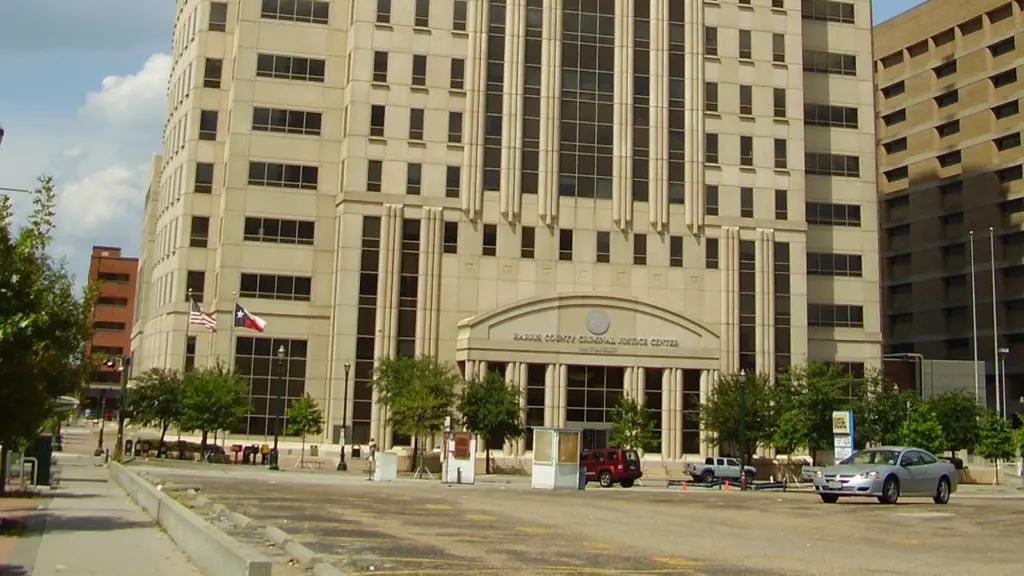
The Harris County Criminal Justice Center in downtown Houston, home to the county's criminal courts. Photo: WhisperToMe, public domain, via Wikimedia Commons.
Harris County commissioners will be asked on Dec. 3 to accept 14 grants from the Texas governor’s Criminal Justice Division worth a combined $6.51 million, money that pays for prosecutors’ victim advocates, a set of specialty courts and a jail-based drug treatment program for the 2027 fiscal year.
The awards are spread across the Dec. 3 Commissioners Court agenda, filed separately by the District Attorney’s Office, the District Courts, Domestic Relations, a constable and the Office of County Administration. Taken together, they also commit the county to about $1.70 million in matching money of its own.
Each award is its own agenda item, but read together they show how much of the county’s court and victim-services work depends on yearly state awards that departments have to reapply for, and how small some of the programs are.
Most of the money goes to victim services
The largest single item, agenda file 26-7774, is a $3.76 million award to the District Attorney’s Office for its Victim Assistance Project, with a required cash match of $1.07 million from the county. The DA has two more on the list: $400,000 for a Special Victims Prosecution and Protective Order Project, with a $171,430 match, and $175,000 with no match for a peace officer mental health grant in the office’s Behavioral Health Division.
Domestic Relations is asking to accept $370,500 for a family victimization program tied to supervised visitation, with a $163,429 match. Smaller victim-assistance awards go to the Office of County Administration ($70,121) and the Precinct 5 Constable ($167,267.20, with a $41,816.80 match).
Counting the five victim-related items, about $4.76 million of the $6.51 million is earmarked for prosecuting cases with victims and supporting the people in them.
Specialty courts run on smaller checks
The rest is for the county’s treatment-oriented courts and programs, and none of those awards tops $250,000 except one. According to the agenda, County Administration would accept:
- $713,999.25 for the Residential Substance Abuse Treatment Program, with a $237,999.75 match;
- $229,205 for the DWI Sober Courts Program;
- $120,699.92 for the STAR (Success Through Addiction Recovery) drug court;
- $109,542 for the felony mental health courts;
- $83,850 for the Veterans Treatment Court and $74,646.60 for the misdemeanor veterans court; and
- $74,936 for an opioid detox treatment and supervision program.
Separately, the District Courts filed for $163,560 for a CPS Prevention and Rehabilitation Drug Court. That filing says no indirect costs were charged “to maximize the reduced award for direct program services and participant needs.” The agenda does not say what the award was reduced from.
The grants arrive in a busy stretch for county finances. Commissioners set a higher tax rate this fall, which we explained in our look at the 2026 property tax bills, and the Nov. 19 agenda drew attention for a contract the county pulled, the $288,000 Clearview AI deal. The same Dec. 3 agenda also carries a request to file a joint application with the City of Houston for $1.49 million in federal Byrne Justice Assistance Grant money. More county budget coverage is on our Finance page.
Commissioners Court meets at 9 a.m. Thursday, Dec. 3, on the first floor of 1001 Preston St. in downtown Houston. Under the posted notice, residents who want to comment must submit an appearance request at least an hour before the meeting starts and get one minute in total, or can email written comments to the court. The meeting is also streamed on the county’s court video page.
Add The City Reporters as a preferred source on Google (opens in a new tab)
 By
