Dr. David Persse spent 29 years shaping how Houston answers 911
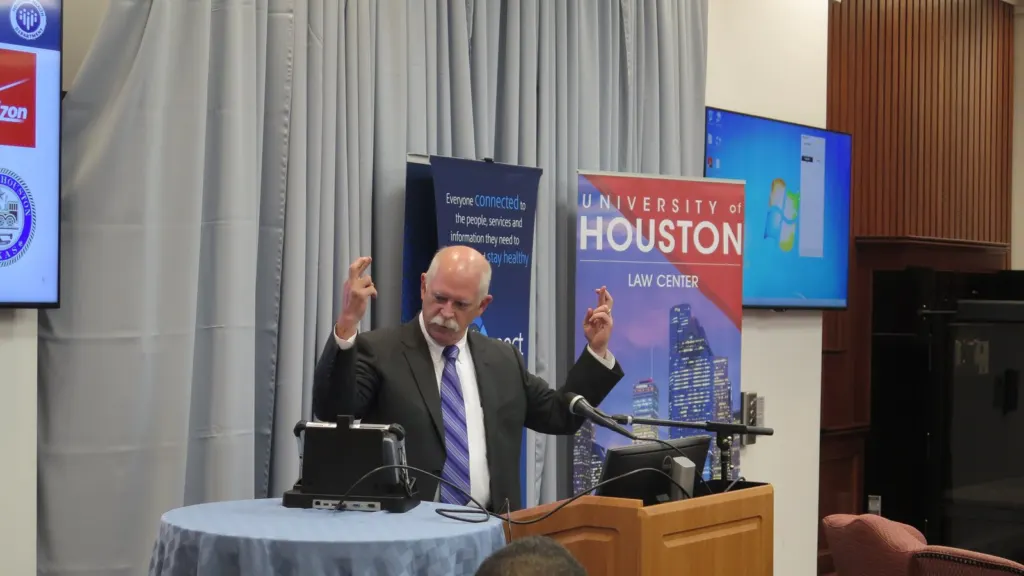
Dr. David Persse demonstrates Houston's ETHAN telehealth program at an FCC event in Houston, May 18, 2016. Photo: Federal Communications Commission, public domain, via Wikimedia Commons.
For almost three decades, if something went wrong with Houston’s health on a large scale, Dr. David Persse was one of the people in the room. Hurricanes, disease outbreaks, a pandemic. On an ordinary day he was doing something less visible and probably more important: deciding how the city’s paramedics treat the people who call 911.
Persse died Sept. 28 after a swimming accident in California, months into his retirement. Family, colleagues and city leaders gathered at Sarofim Hall at the Hobby Center for his celebration of life on Saturday, Nov. 14, KHOU reported.
Paramedic first
Persse came to medicine from the back of an ambulance. He spent 10 years as a field paramedic and paramedic instructor before going to Georgetown University School of Medicine, according to the Houston Fire Department’s announcement of his death. After residency and an EMS fellowship, he worked as an assistant medical director for Houston EMS, then left for Los Angeles County.
He came back in 1996 to run medical direction for the city’s EMS system. Inside HFD the job is known by its radio designation, MD-1, and he held it for 29 years. Every protocol a Houston paramedic follows, from cardiac arrest to overdose, ran through that office.
What he built
Two programs carry his fingerprints more than any others.
The first is the Mobile Stroke Unit, an ambulance with a CT scanner on board. With a stroke, every minute counts, and a scan in the driveway means a doctor can start clot-busting treatment before the patient reaches a hospital.
The second is ETHAN, short for Emergency Tele-Health and Navigation. It answers a problem every big-city EMS system has: a large share of 911 calls are not emergencies, but each one ties up an ambulance and an ER bed. Under ETHAN, paramedics on certain calls connect the patient by video with an emergency physician, who can send them to a clinic by cab instead of to an ER by ambulance. The photo above shows Persse demonstrating the system at a Federal Communications Commission telehealth event in Houston in May 2016.
He was also a tactical physician with the Houston Police Department’s SWAT team for years, and he wrote or co-wrote more than 50 peer-reviewed papers. HFD says he trained thousands of EMS providers and a generation of EMS physicians.
The city’s doctor
City Council named Persse Houston’s Public Health Authority in 2004, and he later became the city’s Chief Medical Officer. That put him in front of cameras through major hurricanes, infectious disease scares and the COVID-19 pandemic, often explaining orders that were not popular.
“His knowledge and experience helped guide my administration through emergencies and some of our city’s most challenging public health issues,” Mayor John Whitmire said in the HFD release.
Fire Chief Thomas Muñoz put it in department terms. “For more than 30 years, he helped shape the way our firefighters and paramedics care for people on the worst days of their lives,” he said. “He challenged us to be better, pushed EMS forward and never lost sight of the people behind the medicine.”
How it ended
Persse retired earlier this year. In late September he was swimming off Hermosa Beach, California, when he suffered a severe spinal injury. He was pulled from the water in cardiac arrest, and bystanders and Los Angeles County first responders brought him back. He died two days later, on Monday, Sept. 28, with his family around him.
There is a hard irony in that. He spent his life building systems so that strangers would act fast when someone collapsed, and in the end strangers and paramedics on a California beach did exactly that.
He is survived by his wife, Beverly, and daughters Courtney and Carrie.
A Houston medical legacy
Houston’s reputation in medicine is often told through its surgeons, like Michael DeBakey and Denton Cooley. Persse worked at the other end of the chain, in the minutes before a patient ever reaches a hospital. If you have called 911 in Houston and gotten fast, sensible care, or gotten through a storm season with clear instructions on when to leave, some of that traces back to him.
More profiles of the people who shaped Houston are in our Spotlight section.
Add The City Reporters as a preferred source on Google (opens in a new tab)