Houston’s Odia community brings Bali Jatra to Fuqua Street
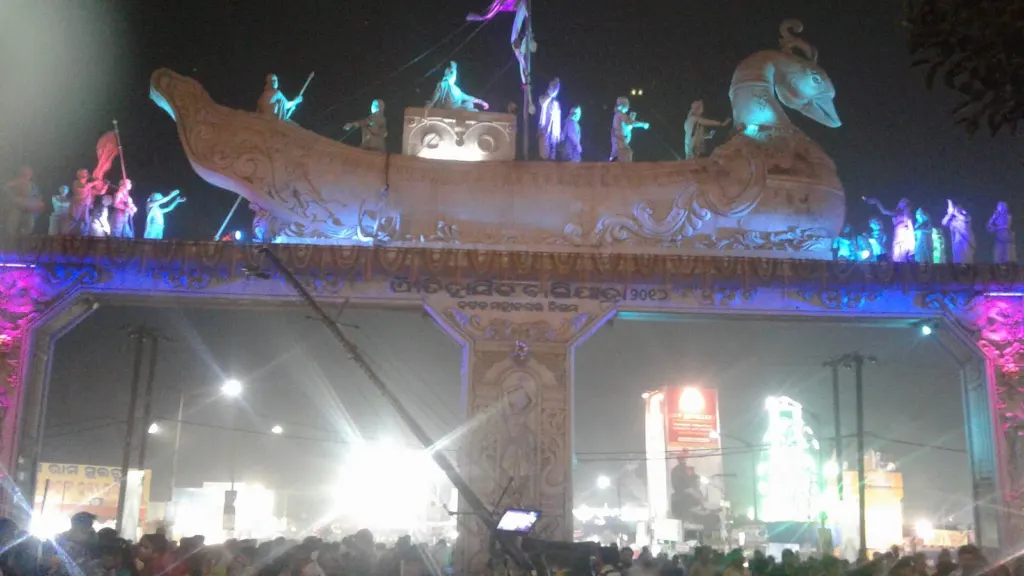
The Bali Jatra fair in Cuttack, Odisha, the festival the Houston event is named for. Photo: Pkp05, CC BY-SA 4.0, via Wikimedia Commons.
Centuries ago, merchant sailors from the eastern Indian region of Odisha set out each autumn for Bali, Java, Sumatra and Sri Lanka. This weekend, that seafaring history gets a celebration on Fuqua Street in southeast Houston.
The Orissa Culture Center’s second annual District D Fall Festival: Bali Jatra runs Saturday and Sunday, Nov. 14 and 15, at the center, 3101 Fuqua St. It is free and open to everyone, according to the center’s event page.
A voyage to Bali
Bali Jatra means “voyage to Bali.” It commemorates the merchant sailors of ancient Kalinga, known as Sadhabas, who traded across the Indian Ocean and as far as Africa, carrying art, language and ideas along with their cargo. In Odisha the tradition is marked with Boita Bandana, the floating of small symbolic boats on Kartika Purnima, the full moon of the autumn month of Kartika.
In the old city of Cuttack, Bali Jatra has grown into a fair that runs for more than a week along the banks of the Mahanadi River, with thousands of stalls selling crafts, food and goods. It draws millions of visitors and is often described as one of Asia’s largest open-air trade fairs.
Houston’s version is much smaller but has grown quickly. The center first introduced Boita Bandana to local families in a modest form in 2011. Last year’s first two-day festival, Nov. 15 and 16, 2025, drew more than 3,000 people, organizers said.
More than one culture on the stage
The center is pitching this year’s event as a festival for the whole district, not only for Houston’s Odia community. Performances are planned from African, Hispanic, South Asian and Southeast Asian traditions, along with presentations on Odisha’s maritime history. Riyaaz Qawwali, an ensemble that performs qawwali, the Sufi devotional music of South Asia, is among the featured acts. There will also be local artists and youth performers, hands-on art activities, cultural demonstrations, family programming, international food and booths for artisans and small businesses.
Organizers say the goal is to give local and underrepresented artists a public stage and to let young people learn from experienced performers so the traditions carry forward. Families, seniors, immigrants and longtime residents take part as volunteers, vendors and performers as well as audience members.
The festival has backing from several directions. The center credits District D Council Member Dr. Carolyn Evans-Shabazz with helping grow it into a significant community event. Funding support comes from the Houston Arts Alliance and the Texas Commission on the Arts. The Consulate General of India in Houston and India’s Ministry of External Affairs have also endorsed it, part of a busy season of consulate-backed events that included a Diwali celebration at City Hall in late October.
The commercial side is deliberate. Organizers describe the vendor rows as a nod to the Cuttack fair’s trade roots, and they say the weekend is meant to support local artisans, food sellers and small-business owners as much as the performers on stage.
Odisha in the Bayou City
Odisha, formerly spelled Orissa, is a coastal state on the Bay of Bengal with its own language, Odia, and a distinct temple, dance and textile tradition. The Orissa Culture Center is a registered nonprofit, and its Fuqua Street grounds host the festival’s stages, vendors and food.
It is one of several Indian community events on the city’s November calendar; the World Malayali Council’s “Dakshin Fest” follows on Nov. 20.
For the Bali Jatra organizers, the link to Houston is easy to draw. Odisha’s festival honors a port culture and long-distance trade. Houston is a port city built on the same things.
Festival details are posted on the Orissa Culture Center’s website. Our earlier coverage of Houston AfriFEST has more on the city’s festival season.
Add The City Reporters as a preferred source on Google (opens in a new tab)
 By